 By Vitor Mattos
CRL (Certificate Revocation List) Implementation in LibreSign
The Certificate Revocation List (CRL) is an essential technical feature for any solution that takes digital certification and security seriously. Although it is not always visible to end users, it plays a critical role in the trustworthiness of digital signatures.
What is a CRL?
The digital certificates used to sign documents are issued by a Certificate Authority (CA). This authority is responsible for maintaining a list containing the serial numbers of all revoked certificates, including the certificate of the certificate authority itself.
When a CA supports CRL, the issued certificate includes a public URL pointing to the revocation list. This URL allows systems and validators to check, at any time, whether a specific certificate has been revoked.
When can a certificate be revoked?
Certificate revocation may occur for several legitimate reasons, such as:
- An employee leaving the organization
- Death of the certificate holder
- Compromise or loss of the password or private key
- Security incidents
In these situations, keeping the certificate active would represent a security risk.
How does CRL-based validation work?
When a document is signed using a certificate that has an associated CRL, this information is embedded in the signature data.
When validating the document with a CRL-compatible system, the following process takes place:
- The CRL URL is queried
- The certificate serial number is checked against the list
- The revocation date is compared with the signature date
If the certificate was revoked before the signing date, the document is considered invalid, as it was signed using a certificate that was no longer trustworthy at that time. If the revocation occurred after the signing date, the signature remains valid.
What has changed in LibreSign?
From now on, CRL support is a standard feature in LibreSign.
This means that:
Before signing, LibreSign checks whether the user's certificate has been revoked
- If it has, the system requests the creation of a new certificate
- In LibreSign, this simply requires defining a new password, provided that the administrator has enabled internal certificate issuance
During document validation, LibreSign:
- Queries the CRL (when published and accessible by the certificate authority)
- Verifies the certificate's validity
- Displays the CRL URL
- Presents validity information for both the signer's certificate and the issuer's certificate
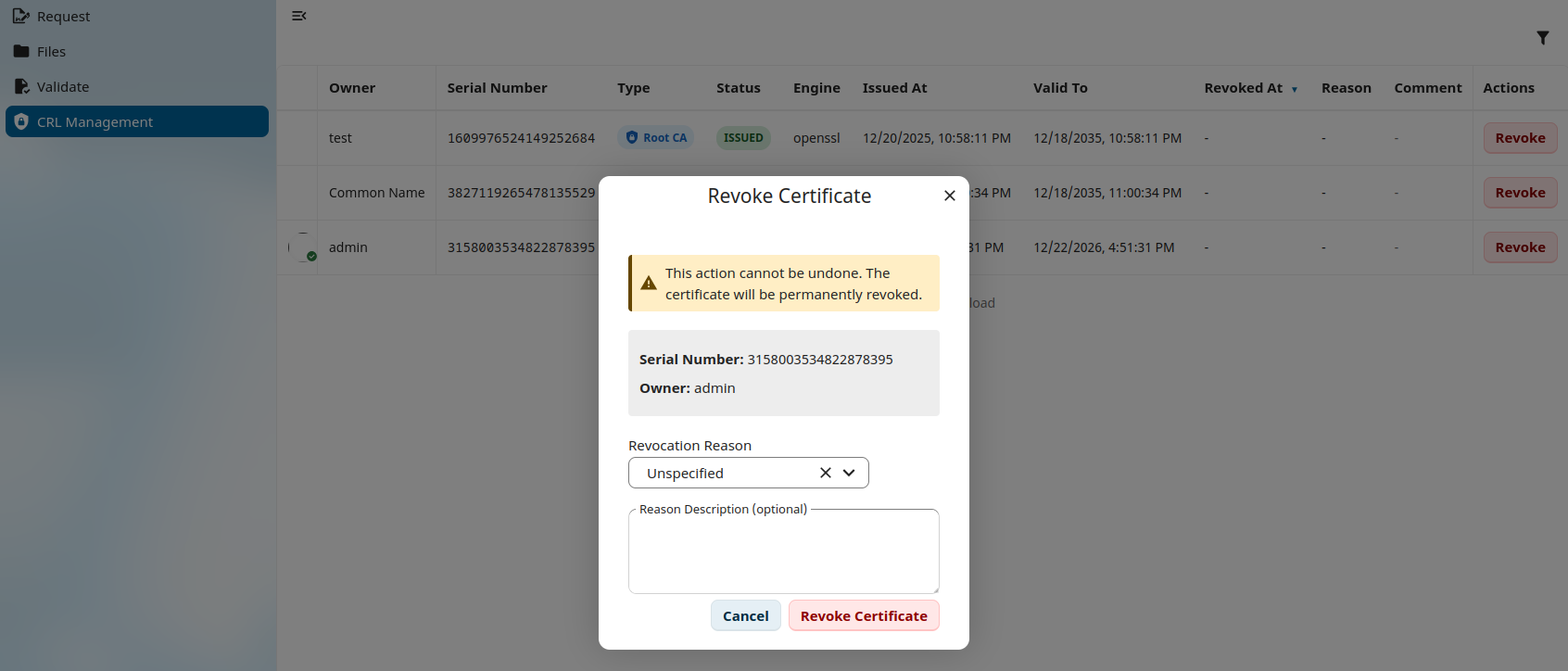
Certificate management, administrators can:
- Manage the certificate revocation list
- Revoke any certificate when necessary
Why is this important?
With the implementation of CRL, LibreSign:
- Raises the level of cryptographic security
- Ensures greater legal reliability
- Aligns with international best practices for digital signature validation
- Prevents the misuse of compromised certificates
This is another step in LibreSign's commitment to security, transparency, and technical compliance. Security is not an optional feature — it is a design principle in LibreSign.